
The What, Why and How of the TAG Heuer Monaco Evergraph

Is this TAG Heuer’s most impactful launch for decades?
In my position as the Technical Correspondent for Brass Heart, I’ll be approaching each assignment in a structured, blow-for-blow manner, focusing on the What, How, Why, When, and Where of each piece, in an attempt to make complex complications easier to understand, and brands’ motivations for releasing such products more transparent. To this role, I bring 23 years of experience in the watchmaking industry, during which I have most relevantly worked as a WOSTEP-qualified watchmaker specialising in chronographs, quartz technology, and horological theory, and a marketing director responsible for knitting together a product and its story from conception to development. These articles are intended to inform. Questions and feedback are always welcome, so please feel free to engage in the comments section below. Through the Brass Heart platform, we aim to create a passionate community and demystify the business and output of the watchmaking industry.
My first task was assigned by our dear Sam Kessler with no little glee, and received with an anticipatory wince on my part. Talk about diving in at the deep end. A brand new chronograph mechanism that updates something as fundamental as the control component? Testing, to say the least. After a little consideration, however, I decided it might provide the perfect opportunity to put this highly structured, direct analytical method through its paces. The only difficulty I foresaw was not letting the word count get away from me. I wasn’t given a limit, but I realised early on that if I neglected to check in with myself every couple of paragraphs, this could easily get out of hand.
Why? Well, the goal of these articles to explain and inform. That’s all well and good when you’re talking to someone in person and you have time to triangulate an appropriate starting point based on their existing knowledge (or complete lack thereof). When writing for a mass audience, one needs to spend quite some time explaining certain basics, and, truth be told, to do those basics justice would require a small book rather than a reasonably sized article.
I’ve tried to strike a balance with this write up on the new TAG Heuer Monaco Evergraph but if you’re new to the hobby and keen to get to grips with this fascinating new mechanism and feel I’ve started at point that precludes that possibility, get in touch. Even with all my years of experience, I admit, I had to watch several explainer videos several times at slow motion to really get an intuitive feel of what was going on where. Eventually, though, the technology made sense to me, and the feeling that accompanied that epiphany was worth the effort. I hope this article can help you experience the same.

The TAG Heuer Monaco Evergraph, revealed at Watches & Wonders 2026
What is it?
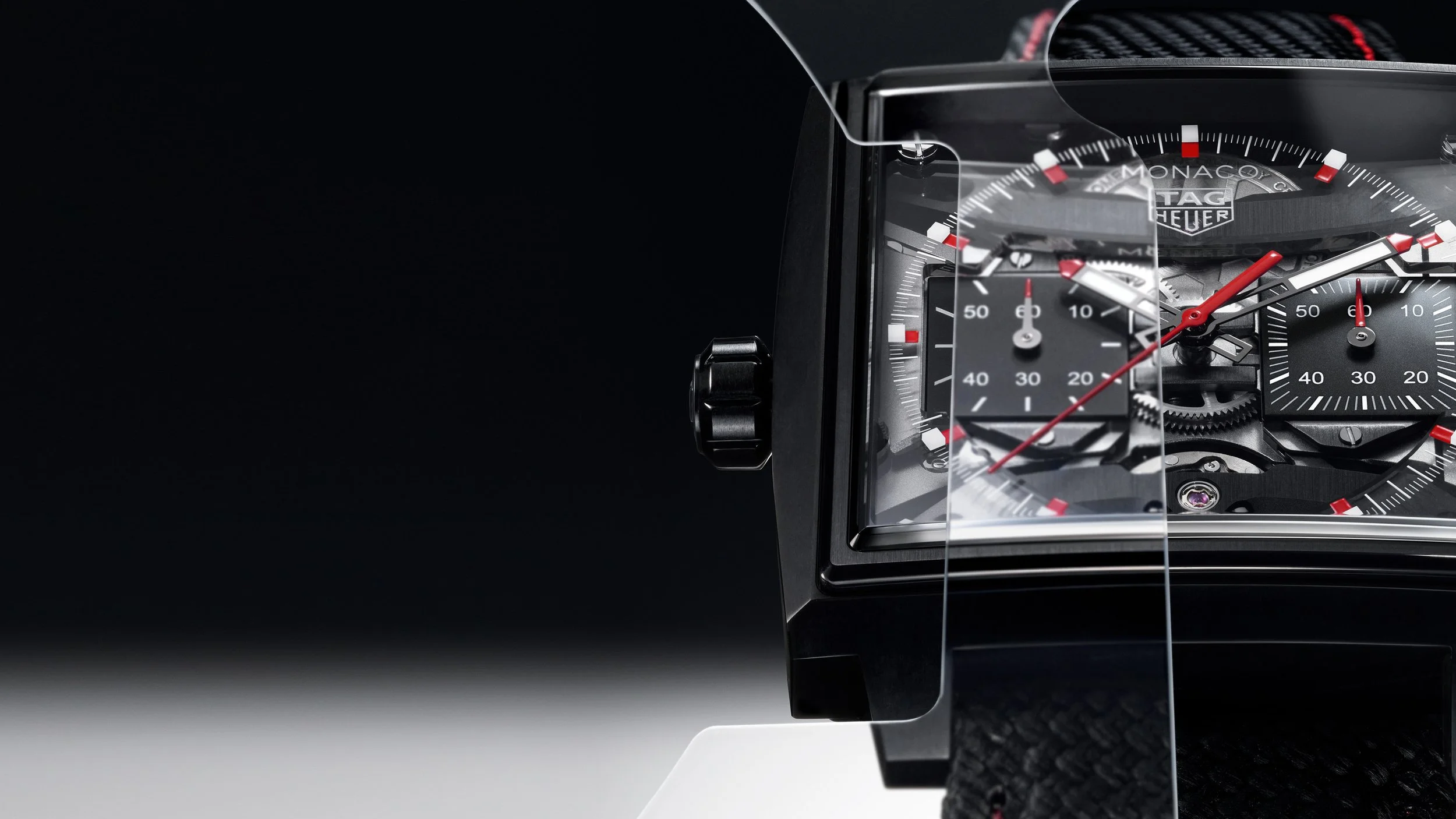
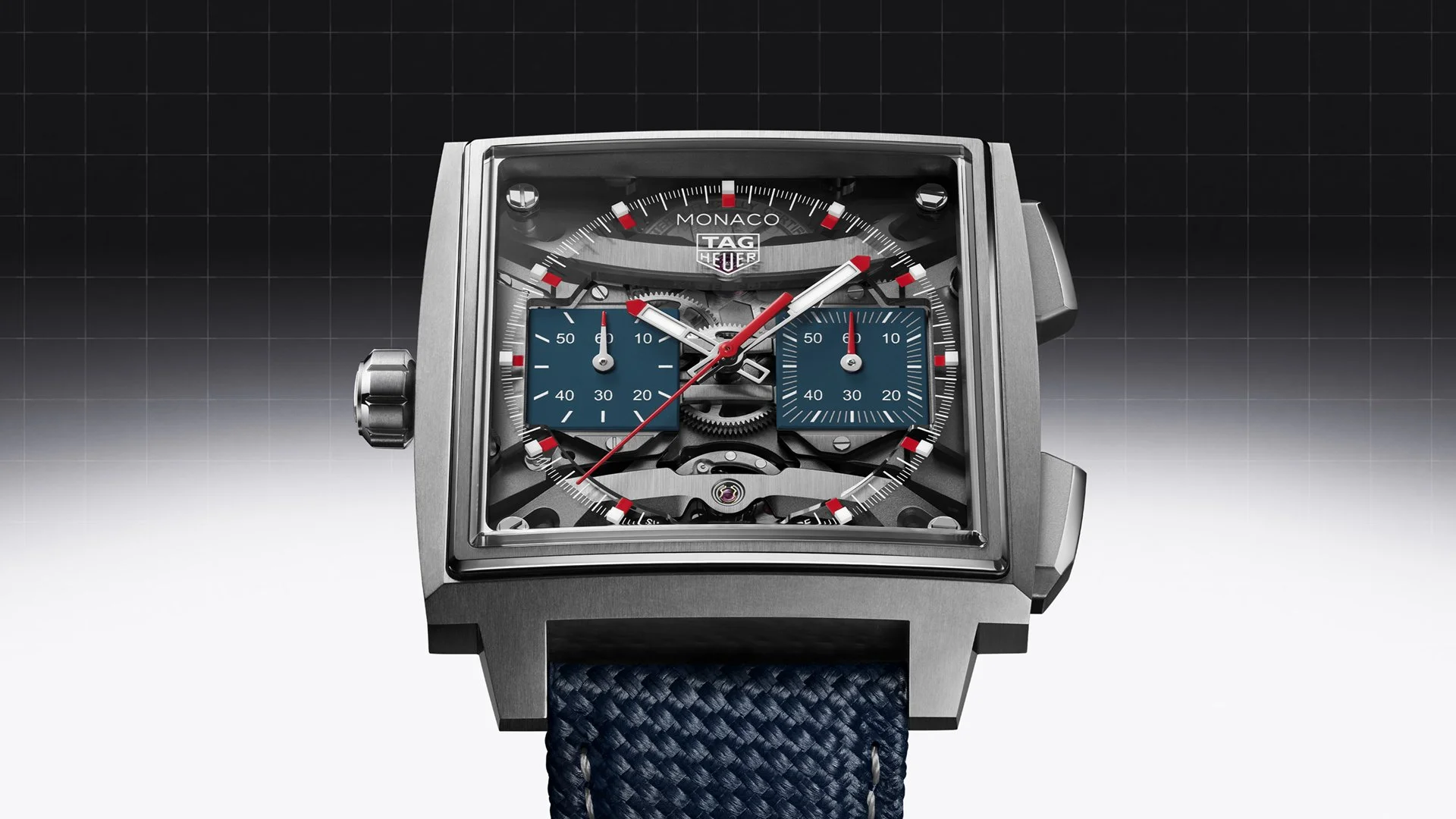
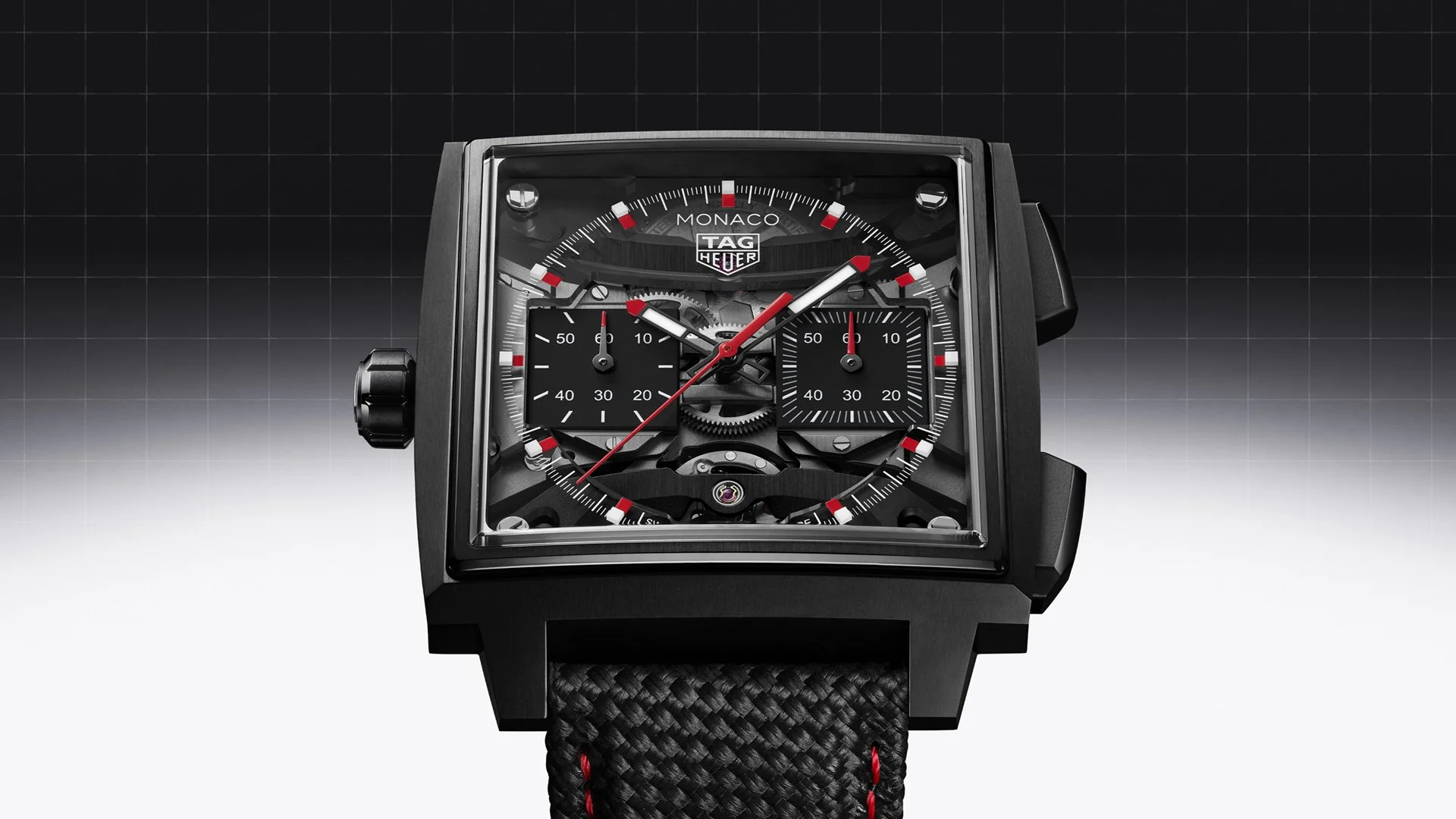
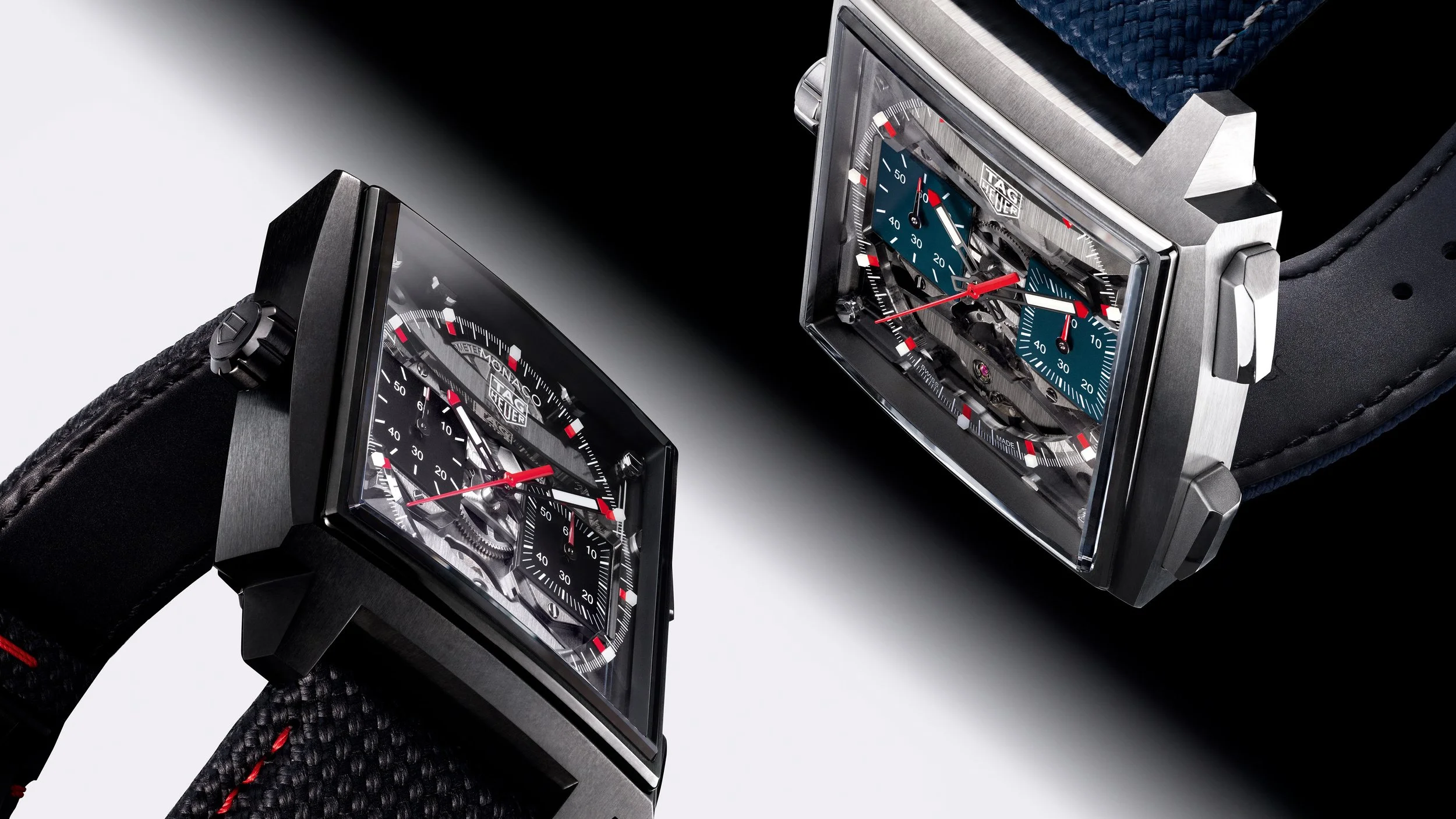
The TAG Heuer Evergraph is a recently released model from the Swiss powerhouse brand known for its long-running association with motor sports. This new in-house square chronograph movement is presented as the latest addition to the brand’s most iconic line, the Monaco. Its 40 mm by 14.5 mm Grade 5 titanium case (available uncoated or with a black DLC finish) boasts the traditional left-hand crown and the elongated pushers at two and four o’clock, recalling the layout of the first ever Monaco from 1969, reference 1133.
Happily, this case is water-resistant to 100 metres, and it comes on a textured rubber strap with a pin and tang adjusted butterfly deployant clasp.
The uncoated titanium case (reference CEW5181.FT8123) features a more traditional Monaco colourway with blue sub-dials and red accents. The anthracite movement bridges visible on the openwork dial are replaced by blackened counterparts for the DLC-coated version (reference CEW5180.FT8122), which gives a far more aggressive account of itself by pairing the moodier case with flashes of the same vivid red. The simpler palette and the addition of red stitching on the strap for reference CEW5180.FT8122 makes it a far more striking proposition aesthetically.
The TH80-00 calibre operates at 5 Hertz for 1/10th-second precision, and is fitted with the in-house developed TH-Carbonspring oscillator, a lightweight, shock-resistant, and antimagnetic regulating organ. Low-friction and capable of exceptional isochronism, the TH-Carbonspring in conjunction with a powerful mainspring, offers 70 hours of power reserve.
Ultra-advanced, form-fitting calibres have been seen from TAG Heuer before, but it’s been a while since we’ve seen anything this interesting and, despite its still-significant price tag of just under $29,000, affordable.
In the early 2010s, TAG Heuer frequently wowed fans of Haute Horlogerie with ever more precise split-second chronographs. Models like the Mikrograph, Mikrotimer, and (conceptual) Mikrogirder were able to show elapsed time readouts of 1/100th, 1/1,000th, and 5/10,000th of a second, respectively.
All of them commanded (or would have commanded in the case of the not-for-public Mikrogirder) much more intimidating RRPs. The Mikrograph 1/100th was on the market for around $50,000. If you fancied adding the Mikrotimer 1/1,000th to your collection, you’d have been asked to shell out $120,000. And the unreleased Mikrogirder was projected to retail for a thoroughly reasonable $65,000 had it ever hit the market.
For context, those prices date from January 2011, March 2011, and January 2012. Considering the cumulative interest of the last fifteen years stands around 46.8%, those prices will seem even more incredible to a modern audience. Therefore, as “not cheap” as the Monaco Evergraph may be in absolute terms, it is certainly a lot of technology for the money, relatively speaking.
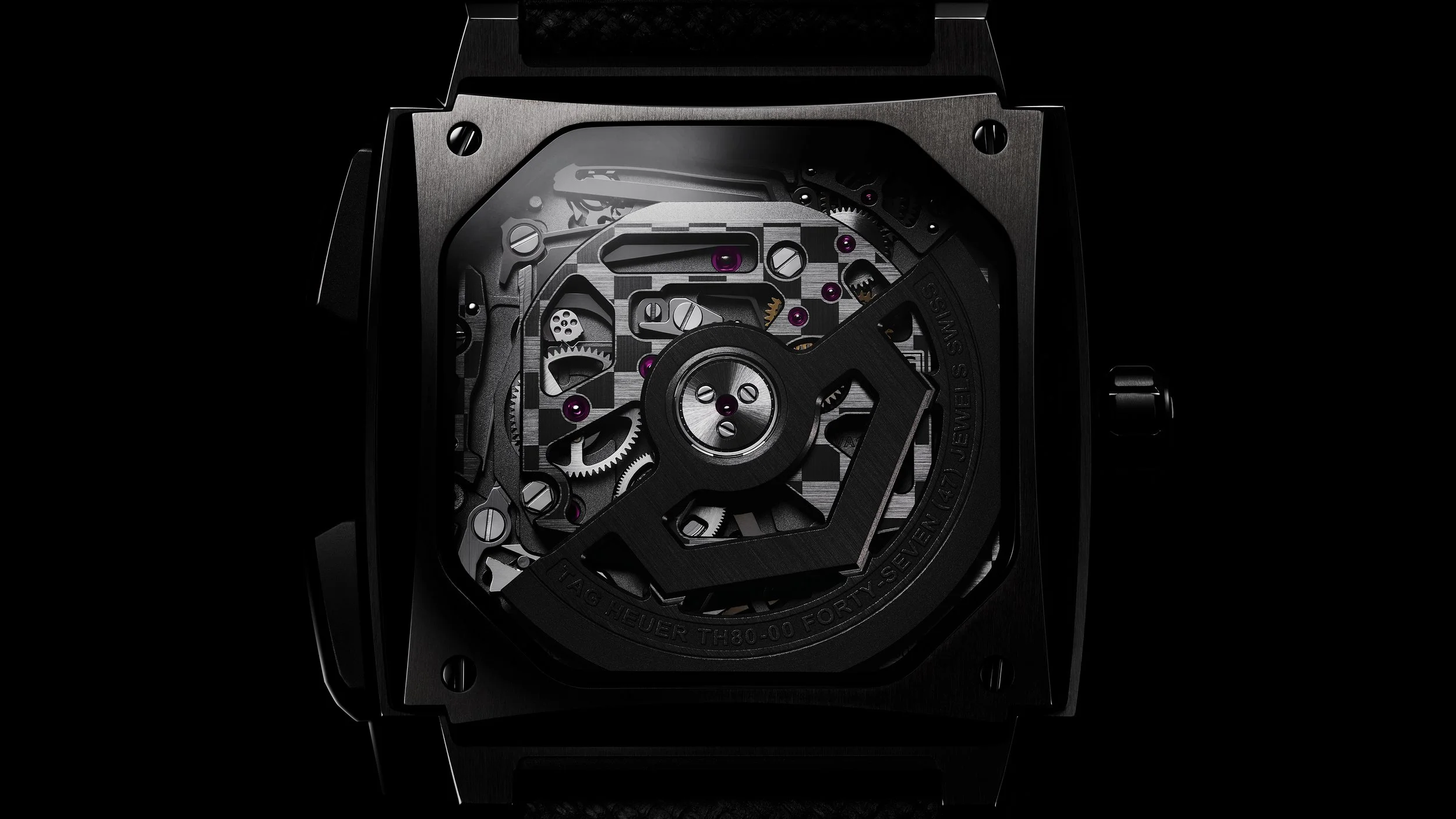
The new TH80-00 calibre carries the torch for TAG Heuer’s historical chronograph ingenuity
How does the new TH80-00 calibre actually work?
This is where it gets interesting. All chronographs require a “control component”. This is a specific part that translates the depression of the start/stop and reset pushers into mechanical action within the movement. By actuating the control component, the chronograph can be coupled and decoupled from the going train via a clutch (either vertical or horizontal), and reset via the interaction of one or more hammers and the heart cams attached to every information-displaying wheel in the chronograph mechanism (generally, seconds and minutes, and sometimes hours).
Heart cams have one flat side and two curved sides that meet opposite the centre of the flat side. They are so named as they vaguely resemble a cartoon heart (albeit with its “head” chopped off). They are used to return any elapsed time indicator to zero. This is achieved by pressing the rest button, which engages flat-surface-tipped hammers, which slam into the heart cam, applying enough pressure to rotate the wheel to the point at which the two flat surfaces (that of the hammer and that of the heart cam) meet.
The two most common forms of control component are a multi-part, multi-level cam and a single-piece column wheel. Here, however, TAG Heuer has employed a novel approach that vastly reduces the number of necessary components, the wear experienced on the remaining components during use, and the effectiveness and reliability of the reset function.
The traditional control component has been replaced by a “flexible bistable” blade, which engages with a complex, single piece hammer made of the same biflexible material.
It is perhaps better to describe these components as bistable, compliant mechanisms — engineering structures designed to flex, twist, or deform in a controlled manner to perform a mechanical task before returning to their original shape. By combining conventional parts such as hinges, bearings, and springs into a single flexible element, these mechanisms can reduce weight, eliminate backlash, and improve long-term reliability through lower friction and fewer points of wear.
Everyday examples that perform in exactly this way are hard to come by, but the best I could think of for explaining how these compliant mechanisms work is one of those old school snap bracelets we all used to have when we were kids (the ones that were very commonly made from reflective materials and worn to increase visibility on or nearby roads).
A snap bracelet is effectively a bistable strip that flips from straight to curled when triggered, using stored elastic energy. When a snap bracelet is straightened out, it is “charged” or perhaps more accurately “primed”. When it is curled up, it is at rest. Interestingly, the bistable monolithic hammer found in Calibre TH80-00 is never “at rest” while in the movement. It exists in two different “active” positions, both primed to flip to the other upon demand. This is an important distinction. A snap bracelet provides its own energy to curl up, but we must provide the energy to reset or “reload” it by straightening it out with our hands. Since we can’t get inside the movement to rearm the hammer once it has been activated, it cannot afford to skip to an inactive state at any point.
If you remove the hammer component from the TH80-00 and lay it flat on your workbench, you will see that the three thin bars that run almost in parallel to one another are all straight (check out the image above — Flexible Bistable Hammer at rest). This is the same as a snap bracelet being curled up. There is no elastic energy stored in the component in this state. The hammer is mounted in the movement under tension, flexing it into one of its two primed states (as shown in the two images below — Chronograph Running and Chronograph Reset. There is not enough space afforded to the component to ever return to its resting state, so it is forced to snap from one active position to the other. This is achieved by levers engaged by the start/stop and rest pushers, which force the hammer from one position to the other, replacing the traditional control component options in the process.
What is so special about this component is how is it is simultaneously a linear hammer and its own spring. That total loss of energy and the inherent constant force applied to the heart cams of the central seconds and minute counter ensures total reliability and near-instantaneous reset. It really is ingenious and is only possible thanks to the avant-garde creation technique TAG Heuer has clearly mastered.
These flexible bistable components are created by a process known as LIGA, enabling TAG Heuer to achieve the exact tensions necessary. LIGA stands for Lithographie, Galvanoformung, Abformung, and is a high-precision micro-manufacturing technique. It allows for the creation of intricate, monolithic parts made from a nickel-phosphorus alloy, which are anti-magnetic, highly durable, and require little to no lubrication. Tests conducted by the TAG Heuer LAB show no reduction in performance after more than 10,000 actuations.
The movement was developed by the team of Carole Forestier-Kasapi, a name you may have heard of before in the news recently, as her brainchild, the Ulysse Nardin Freak, recently celebrated 25 years on the market, after she conceived the concept en route to winning the Breguet Prize in 1997 (when she was just known as Carole Forestier).
Why does it matter?
Genuine advancements in watchmaking technology are always welcome; offering the industry a new perspective on an age-old mechanism can only result in wider spread progress. From a branding perspective, TAG Heuer must maintain its position as an innovator, a characteristic upon which the brand has dined out since the glory days of Jack Heuer’s imaginative and boundary-pushing tenure as CEO (which ran from 1962 until 1982), and most notably, gave us the legendary Calibre 11 “Chronomatic”: one of watchmaking’s first three integrated chrongraph movements alongside the Zenith El Primero and Seiko calibre 6139, which all debuted in 1969.
The Evergraph puts the modern iteration of the brand (which acquired the TAG prefix following Techniques d'Avant Garde’s acquisition of the brand in 1985) back on the map. And while an almost 30K USD price tag puts this watch way out of reach of most customers, it is a relatively — emphasis on the relatively — fair price for the kind of research and development that went into the creation of a true novelty. Though hopefully it will come down a bit in the future.
When and where can you buy one?
The TAG Heuer Monaco Evergraph is available now and can be purchased via TAG Heuer itself or the brands’ dealers worldwide. Deliveries are expected to commence immediately. This piece is not limited and will become a mainstay in the collection for the foreseeable future. The price in USD is $28,500, £20,750 in GBP, or CHF 23,000 in Swiss Francs, for both executions.